Dr. David Kulla, DC provides individualized evaluation and conservative care for hip, sacroiliac, knee, and leg problems at Synergy Wellness Chiropractic & Physical Therapy in New York City.
With more than 26 years of clinical experience, Dr. Kulla evaluates musculoskeletal and nerve-related conditions that may cause pain, stiffness, weakness, numbness, altered gait, or reduced mobility in the lower back, pelvis, hips, knees, and legs.
Our Manhattan office is located at 237 First Avenue near East 14th Street, convenient to Union Square, the East Village, and Gramercy.
What Causes Hip, Knee and Leg Pain?
Pain in the hip, buttock, knee, or leg can originate from many different structures. In some patients, the problem is local to the painful joint or muscle. In others, symptoms may be referred from the lower back, sacroiliac joint, or a spinal nerve.
Common causes and contributing factors may include:
- Hip or knee osteoarthritis
- Muscle or tendon strain
- Sacroiliac joint pain
- Hip bursitis or tendon irritation
- Meniscus or ligament injury
- Patellofemoral knee pain
- Sciatica
- Lumbar disc conditions
- Lumbar spinal stenosis
- Degenerative changes in the lower back or pelvis
- Sports or repetitive-use injuries
- Foot and lower-extremity mechanics
The Hip Joint
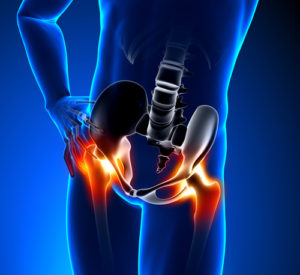
The hip is a ball-and-socket joint formed by the head of the femur and the acetabulum of the pelvis. It is surrounded by cartilage, muscles, tendons, ligaments, and other soft tissues that provide both stability and movement.
Hip pain may be felt in the groin, outer hip, buttock, or thigh depending on the structure involved.
Common hip conditions include arthritis, tendon disorders, bursitis, labral injuries, muscle strains, and referred pain from the lumbar spine or sacroiliac region.
Sacroiliac Joint Pain
The sacroiliac, or SI, joints connect the sacrum at the base of the spine to the pelvis. SI joint pain is commonly felt in the lower back or buttock and may sometimes extend into the thigh or leg.
Activities such as prolonged sitting or standing, stair climbing, running, transitioning from sitting to standing, or standing primarily on one leg may aggravate symptoms in some patients.
SI joint pain can be difficult to distinguish from other causes of lower-back and buttock pain, including disc conditions, hip disorders, and nerve irritation. A careful history and physical examination are therefore important.
Hip Pain or Sciatica?
Hip-region pain does not always originate from the hip joint.
Sciatica or lumbar nerve irritation can produce pain, numbness, tingling, or weakness extending through the buttock and leg.
True hip-joint problems are more likely to produce pain in the groin or around the hip and may cause difficulty with activities such as walking, climbing stairs, putting on shoes, or rotating the leg.
Because symptoms can overlap, evaluation of both the lumbar spine and hip may be appropriate.
Knee Pain
Knee pain may originate from cartilage, ligaments, tendons, muscles, the meniscus, kneecap, or the joint surfaces themselves.
Common knee problems include:
- Patellofemoral pain
- Meniscus injuries
- Ligament sprains
- Tendon irritation
- Osteoarthritis
- Overuse injuries
- Sports injuries
Treatment depends on the diagnosis and may include activity modification, strengthening, mobility work, physical therapy, and gradual return to normal activity.
Can Foot Mechanics Affect the Knee or Hip?
Foot and ankle mechanics can influence movement throughout the lower extremity. In some patients, excessive foot pronation, restricted ankle motion, weakness, or altered gait may contribute to stress at the knee or hip.
However, not every person with flat feet develops knee, hip, or back pain, and foot posture alone should not be assumed to be the cause of symptoms.
When appropriate, Synergy Wellness can evaluate lower-extremity mechanics and determine whether footwear changes, rehabilitation, or foot and running-injury care may be useful.
Leg-Length Differences
Some people have a true structural difference in leg length, while others appear to have an asymmetry because of positioning, joint restriction, scoliosis, pelvic mechanics, or other functional factors.
Small asymmetries are common and do not always cause symptoms.
When a clinically meaningful leg-length discrepancy is suspected, examination and appropriate imaging can help determine whether the difference is structural and whether it is relevant to the patient’s symptoms.
How Are Hip, Knee and Leg Problems Evaluated?
Dr. David Kulla, DC evaluates each patient based on the location and pattern of symptoms rather than assuming the pain originates from one specific joint.
An examination may include:
- Detailed health and injury history
- Gait and movement assessment
- Hip and knee range-of-motion testing
- Muscle strength testing
- Orthopedic examination
- Neurological testing when nerve symptoms are present
- Assessment of the lumbar spine and sacroiliac joints
- Evaluation of foot and lower-extremity mechanics
- Review of previous X-ray or MRI studies when available
Additional imaging or specialist referral may be recommended when the examination suggests fracture, significant joint damage, severe arthritis, major ligament injury, neurological impairment, or another condition requiring further evaluation.
Conservative Treatment Options
Treatment depends on the diagnosis, severity of symptoms, activity demands, neurological findings, and individual goals.
Care at Synergy Wellness may include:
- Physical therapy and rehabilitation
- Therapeutic exercise
- Hip and lower-extremity strengthening
- Mobility and flexibility work
- Balance and gait training
- Soft-tissue techniques
- Chiropractic care when spinal or joint mechanics are relevant
- Activity and ergonomic modification
- Foot and lower-extremity evaluation when appropriate
The goal is to improve movement, strength, function, and activity tolerance while addressing the structures identified during the examination.
Physical Therapy for Hip and Knee Pain
Physical therapy is an important conservative option for many hip and knee conditions.
Rehabilitation may focus on strengthening the muscles around the hip and knee, improving range of motion and balance, correcting movement limitations, and gradually returning the patient to walking, exercise, sports, or daily activities.
For mild to moderate hip osteoarthritis, physical therapy can improve function and reduce pain in appropriately selected patients.
Chiropractic Care for Hip, SI and Leg Symptoms
Chiropractic care may be considered when examination findings indicate that restricted movement or mechanical dysfunction in the lumbar spine, pelvis, sacroiliac joints, or other joints is contributing to the patient’s symptoms.
Treatment may include mobilization, manipulation, soft-tissue techniques, exercise, and rehabilitation depending on the diagnosis.
Not every hip, knee, or leg condition originates from the spine, and chiropractic treatment should not replace appropriate orthopedic, neurological, or medical evaluation when those services are needed.
Pregnancy and Sacroiliac Pain
Pregnancy can place additional mechanical stress on the pelvis and sacroiliac joints as body weight, posture, gait, and ligamentous support change.
Pregnancy-related lower-back or pelvic pain should be evaluated individually. Appropriate exercise, physical therapy, activity modification, and other conservative approaches may be considered in coordination with the patient’s obstetric healthcare team.
We do not assume that spinal or pelvic alignment determines labor outcomes or guarantees an easier delivery.
When Hip, Knee or Leg Pain Requires Prompt Medical Evaluation
Seek prompt medical evaluation for:
- Inability to bear weight after an injury
- Obvious deformity or suspected fracture
- Rapidly increasing swelling or redness
- A hot, swollen joint with fever
- Progressive leg weakness
- New bowel or bladder dysfunction
- Numbness in the groin or saddle region
- Sudden calf swelling, warmth, or unexplained shortness of breath
- Severe pain following significant trauma
Hip, Knee and Leg Pain Video
This video from Dr. David Kulla and Synergy Wellness discusses lower-extremity symptoms and conservative treatment approaches.
Schedule a Hip, SI, Knee or Leg Evaluation in NYC
If you are experiencing hip pain, buttock pain, knee pain, leg symptoms, weakness, stiffness, or reduced mobility, Dr. David Kulla, DC can evaluate your condition and help determine appropriate conservative treatment options.
Synergy Wellness Chiropractic & Physical Therapy
237 First Avenue, 5th Floor
New York, NY 10003
Near East 14th Street in Manhattan
Call (212) 533-4900 or book an appointment online.