Who May Benefit From Custom Foot Orthotics?
Custom orthotics may be considered when examination findings suggest that additional support, pressure redistribution, or modification of foot mechanics could improve symptoms or function.
Conditions in which orthotics may sometimes be considered include:
- Plantar fasciitis
- Symptomatic flat feet
- High arches
- Selected foot and ankle pain
- Recurrent overuse injuries
- Running-related foot problems
- Pressure-sensitive areas of the foot
- Selected Achilles or tendon-related problems
- Foot mechanics contributing to difficulty with walking or activity
The presence of one of these conditions does not automatically mean that custom orthotics are necessary.
Custom Orthotics for Plantar Fasciitis
Orthotics are one conservative treatment option for plantar fasciitis and plantar heel pain.
They may help redistribute pressure and support the foot while irritated tissues recover.
Orthotics are generally most useful as part of a broader treatment plan that may also include:
- Plantar fascia stretching
- Calf and Achilles stretching
- Foot and ankle strengthening
- Activity modification
- Appropriate footwear
- Gradual return to walking or running
- Physical therapy when indicated
Research suggests both prefabricated and custom orthotics may help some patients with plantar heel pain, and a custom device is not automatically superior for every patient.
Custom Orthotics for Flat Feet
Flat feet, also called pes planus, are common.
Many people with low arches experience no pain or limitations and require no treatment.
When flat feet are associated with persistent pain, fatigue, difficulty with activity, or other clinically relevant findings, an orthotic may be one option for improving support and comfort.
Our goal is not to simply look at an arch and prescribe an insert. The decision is based on the patient’s symptoms, examination, footwear, activities, and overall lower-extremity mechanics.
Foot Mechanics and the Kinetic Chain
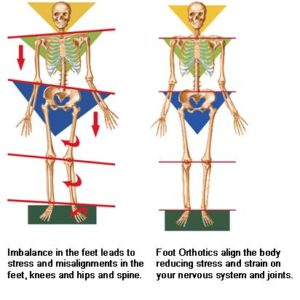
The foot, ankle, knee, hip, and pelvis work together during walking and running.
Changes in mobility or movement at one region can influence forces elsewhere in the lower extremity.
For some patients, foot mechanics may contribute to symptoms involving the knee, hip, or leg.
However, foot posture alone should not automatically be blamed for knee, hip, pelvic, or lower-back pain. These problems often have multiple contributing factors and should be evaluated individually.
What Is Pronation?
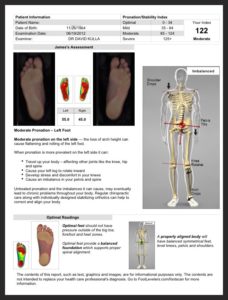
Pronation is a normal motion that occurs as the foot contacts the ground.
It helps the foot adapt to the walking surface and absorb forces.
Pronation itself is therefore not a disease or something that must always be corrected.
In selected patients, excessive or poorly controlled motion may contribute to symptoms, particularly when combined with weakness, restricted mobility, training errors, or repetitive loading.
How We Evaluate Your Feet
Before recommending custom orthotics, Dr. Kulla evaluates more than simply the appearance of the arch.
An examination may include:
- History of foot, ankle, knee, hip, or back symptoms
- Standing foot posture
- Arch characteristics
- Foot and ankle range of motion
- Muscle strength
- Walking and gait mechanics
- Footwear assessment
- Lower-extremity alignment
- Evaluation of the knees and hips when relevant
- Review of previous imaging when appropriate
3D Digital Foot Scanning
Synergy Wellness uses 3D digital foot scanning technology to help evaluate the shape and support characteristics of the feet and assist with the fabrication of custom orthotics when clinically appropriate.
The scan creates a digital representation of the feet that can be used as part of the orthotic-design process.
A 3D scan is a useful fitting tool, but it does not replace the physical examination or independently diagnose the cause of pain.
Custom vs. Over-the-Counter Orthotics
Not everyone needs a custom device.
Over-the-counter inserts may be sufficient for some patients, particularly when symptoms are mild and there is no unusual foot structure or complex biomechanical problem.
Custom orthotics may be considered when:
- Symptoms persist despite appropriate conservative care
- A patient’s foot shape is difficult to accommodate with standard inserts
- Pressure needs to be redistributed from a specific painful region
- There is significant structural asymmetry
- Activity or athletic demands require a more individualized device
- Previous prefabricated inserts have not provided adequate comfort or support
The best device is the one that appropriately addresses the patient’s clinical needs rather than simply the most expensive option.
Do Orthotics Correct Your Entire Posture?
Orthotics can influence how forces are distributed through the foot and may affect movement farther up the kinetic chain.
However, it is not accurate to claim that an orthotic automatically realigns the entire pelvis or spine, prevents arthritis, or makes chiropractic adjustments “hold” for a specific amount of time.
When knee, hip, pelvic, or spinal symptoms are present, those regions should be evaluated directly rather than assuming the feet are the sole cause.
Orthotics for Runners and Active Adults
Runners and active patients place repeated loads through the feet and lower extremities.
When symptoms develop, evaluation may consider:
- Training volume
- Recent increases in mileage
- Running surface
- Footwear
- Foot and ankle mobility
- Strength
- Recovery
- Gait and movement patterns
An orthotic may be useful for some athletes, but it should be part of a broader plan rather than automatically prescribed because someone runs frequently.
Can Orthotics Be Combined With Physical Therapy?
Yes.
For many musculoskeletal foot and lower-extremity conditions, physical therapy may complement orthotic use.
Rehabilitation may address strength, flexibility, ankle mobility, balance, gait, and progressive return to activity.
The orthotic provides support inside the shoe, while rehabilitation helps improve the capacity and function of the patient’s own muscles and joints.
How Long Do Custom Orthotics Last?
The useful life of an orthotic varies according to the materials used, body weight, footwear, activity level, frequency of use, and changes in the patient’s condition.
Orthotics should be reassessed when they become significantly worn, uncomfortable, damaged, or no longer appear to be helping.
Patients do not necessarily need a new pair on an arbitrary yearly schedule.
What Shoes Can I Wear With Custom Orthotics?
Orthotics can be designed for different types of footwear, but shoe fit matters.
A shoe generally needs sufficient interior space, an appropriate heel counter, and enough room to accommodate the device without crowding the foot.
Athletic shoes are often easiest to fit, while dress shoes and other lower-volume footwear may require a thinner device or a different orthotic design.
Custom Foot Orthotics Video
Watch Dr. David Kulla discuss foot mechanics, orthotics, and conservative approaches to foot and lower-extremity problems.